























NoriaTechnologies
Technologies: What only the giants used to have.
Technologies
What only the giants used to have.
AI agents that carry out work of many steps, machines that see, documents that read themselves, products and spaces in 3D from a video. The technologies that changed the largest companies are now within reach of every serious business. We choose them by one test: they must make your work faster, more accurate or more visible.
Let’s talkAI agents
Work of many steps, from one instruction.
An AI agent does more than answer. It opens your systems through their interfaces, finds what it needs, prepares the action and stops where your approval is needed. Every step is written down, so you know what it did and why.
For orders, quotes, service requests, stock checks, reports
ToolsClaudeGPTGeminiMCPA2ALangGraphEvals
Prepare the Kalamaria taverna’s order from its message.
- Read the message from 23:42
- Found customer 20431 in the CRM
- Matched 4 items to their catalogue
- Checked stock: everything available
- Priced it with the customer’s agreements
- Prepared the order for the ERP
A Noria study. Illustrative data.
Computer vision
Machines that see.
A camera and a vision model count, check and recognise: bottles on the line, pallets on the ramp, labels, dimensions, defects before the product leaves. Anything uncertain, they show to a person.
For production, quality control, warehouses, goods in
ToolsApple VisionCore MLARKitLiDARYOLONVIDIA Jetson

A Noria study. Illustrative data.
Documents that read themselves
What arrives on paper enters the system.
Orders by email, delivery notes as PDFs, certificates, handwritten lists in a photo: a model reads them, finds every detail and enters it into the system. For every value it keeps where it read it, and anything uncertain is checked by a person.
For wholesale, production, purchasing, offices
ToolsClaudeGeminiVertex AIAmazon BedrockJSON SchemaZod
From: kitchen, a hotel in Halkidiki
Subject: Order for Friday
Good morning,
we would like 12 cases of one-kilo yoghurt and
3 tins of feta for Friday.
Delivery at the back entrance, after 9.
Thank you, the kitchen
What it read
- Day
- Friday 30 October Certain
- Line 1
- Strained yoghurt 10%, case of 6 × 1 kg · 12 Certain
- Line 2
- Feta PDO in brine, 15 kg tin · 3 Certain
- Note
- Back entrance, after 09:00“After 9” becomes a delivery window To check
A Noria study. Illustrative data.
Real-time voice
It speaks every language, around the clock.
Voice assistants that answer the phone in a natural voice, understand what the caller wants, book appointments and stays, take orders and hand anything that needs judgement to a person. In each caller’s language, connected to what you already use.
For hotels, clinics, service desks, out-of-hours orders
ToolsElevenLabsTelnyxSIPWebRTCSpeech-to-speech
Καλησπέρα σας, πώς μπορώ να βοηθήσω;
A Noria study. Illustrative data.
3D scanning and digital twins
A product, a space, in 3D from a video.
With LiDAR or a phone video, a product, a space or a whole plant becomes a 3D model: for a catalogue and AR, to present a project, or as a digital twin that shows what is happening in production right now.
For furniture, building materials, property, industry, exhibitions
ToolsLiDARRealityKitGaussian splattingBlenderthree.jsWebGPUOpenUSD
A Noria study. Illustrative data.
AI search and agents that buy
When they ask ChatGPT, it should answer with you.
More and more buyers ask an AI system instead of searching. We build pages and data that these systems read and quote, and catalogues an agent buying on a customer’s behalf can read.
For every business that wants to be found
ToolsSchema.orgJSON-LDllms.txtIndexNowACPUCP
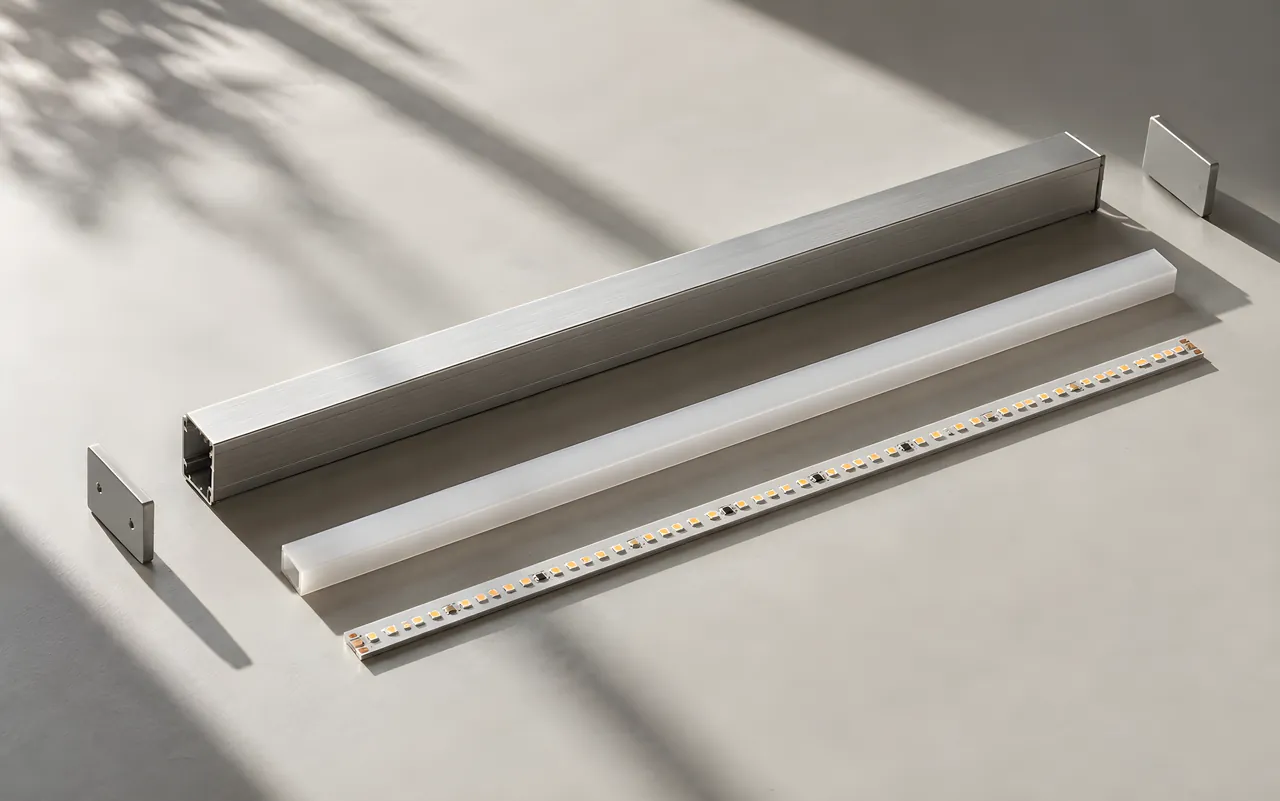
AskedWho in Greece makes aluminium linear luminaires to order?
Lychnis makes aluminium linear luminaires in lengths up to 1,800 mm and in three finishes. Its page for professionals has a configurator that gives the product code, and a quote request for projects.
From Lychnis’s page for professionals
A Noria study. Illustrative data.
Forecasts from your own data
What you will need next week.
From the history of orders, seasons and holidays, a model forecasts demand per product and customer, and when a machine will need maintenance before it breaks. What it forecasts, it shows with its range, never as certain.
For production, wholesale, hotels, service
ToolsPythonBigQuerydbtClickHousepg_cron
A Noria study. Illustrative data.
From the core to the frontier.
At the centre, what we use in every project. Around it, what we bring when a project calls for it. At the edge, the frontier: the technologies that give a business its lead.
- Core
- Specialist
- Frontier
Updated:
Code
Languages, frameworks and APIs, from the screen to the server.
Corein every project
- TypeScriptStrict types, from the database to the screen.
- PythonData, models and automation.
- SQL and PL/pgSQLLogic that belongs next to the data.
- Next.js and React Server ComponentsPages rendered on the server and streamed.
- React Native and ExpoOne codebase for iOS and Android.
- Swift and KotlinNative code, where the phone demands it.
- Node.js and DenoJavaScript on the server and at the edge.
- Zod and JSON SchemaData contracts, checked at runtime too.
- Monorepos with TurborepoApps and packages in one repository, with shared types.
- Playwright and VitestAutomated tests on every release, from unit to browser.
Specialistwhere the project calls for it
- GoHigh-load services with a small footprint.
- GraphQL and gRPCAPIs for systems that talk to each other a lot.
- Passkeys (WebAuthn)Sign-in without passwords, by face or fingerprint.
- SSO with SAML and OIDCOne sign-in for the whole company, from Entra ID or Google Workspace.
Frontierfor those who want to lead
- RustSpeed and memory safety, where they count.
- WebAssemblyMachine-speed code, inside the browser.
- Local-first with CRDTsApps that work offline and sync without conflicts.
Cloud
Infrastructure that scales, on whichever cloud fits the business.
Corein every project
- AWSLambda, ECS, S3 and CloudFront, for whatever has to scale.
- Google CloudCloud Run, Pub/Sub and BigQuery, with the data in Europe.
- DockerEvery service in a container, the same in every environment.
- TerraformInfrastructure written as code, with history and review.
- GitHub ActionsEvery change built, tested and shipped by itself.
- Edge functionsCode close to the user, with no servers to maintain.
- SentryWe see an error before the customer does.
Specialistwhere the project calls for it
- Microsoft AzureFor companies already living in Microsoft 365.
- KubernetesServices that scale and heal themselves.
- Cloudflare WorkersCode in hundreds of cities, in milliseconds.
- OpenTelemetryEnd-to-end traces across every service.
- SQS, EventBridge and Pub/SubEvents and queues that hold through every peak.
- Vault and zero trustNo secret in the code, every access verified.
Frontierfor those who want to lead
- TemporalDurable workflows that survive failures and restarts.
- Multi-region, active-activeSystems that stay up even if a cloud region goes down.
- eBPFObservability and security inside the operating system’s kernel.
- Confidential computingData encrypted even while it is being processed.
Data
From the database to the analysis, in real time.
Corein every project
- PostgreSQLThe source of truth of every system.
- Row-Level SecurityPer-row permissions, enforced by the database itself.
- pg_cron and pgmqJobs and queues inside the database.
- Logical replicationEvery change reaches the screen as it happens.
- pgvectorSemantic search inside the database itself.
- SQLite, offline-firstApps that work without signal and sync afterwards.
- Idempotency and append-only ledgersNo action twice, no trace lost.
- RedisCache and queues in milliseconds.
Specialistwhere the project calls for it
- BigQueryAnalysis over billions of rows, in seconds.
- Apache KafkaEvent streams between ERP, warehouse and online shop.
- CDC with DebeziumEvery change in the ERP becomes an event, without touching the ERP.
- ClickHouseAnalytics in real time.
- dbtData transformations with versions and tests.
- OpenSearchSearch across millions of products that forgives typos.
Frontierfor those who want to lead
- Apache IcebergOpen data tables that every engine can read.
- DuckDBAnalysis over millions of rows, inside the browser.
- Event sourcingA system that remembers every event and can rebuild any moment.
AI
Models, agents and their limits.
Corein every project
- ClaudeReasoning and tool use for agents.
- GPTText, image and voice.
- GeminiLong documents and video in one read.
- MCPThe tools each agent sees, defined precisely.
- Structured outputsAnswers that pass a schema check before they enter the system.
- RAGAnswers only from your own sources, with a citation.
- EvalsEvery change to a prompt or model is measured before release.
- Prompt cachingLess cost and waiting on every call.
- Voice over SIPAgents on real phone lines.
- Image and video modelsPhotographs and films from models, with a studio’s control.
Specialistwhere the project calls for it
- Amazon BedrockModels inside the company’s own AWS account.
- Vertex AIModels and agents on Google Cloud, with the data in Europe.
- Azure OpenAIOpenAI’s models, on Microsoft’s terms.
- LangGraphMany agents with roles, checking one another.
- Computer useAgents that operate screens where there is no API.
- YOLOReal-time object detection.
Frontierfor those who want to lead
- Speech-to-speechVoice that answers without a pause, in real time.
- Fine-tuning with LoRAA model that speaks your industry’s language.
- Open-weight models on vLLMModels on your own infrastructure, with no data leaving.
- A2AAgents from different companies that work things out together.
- ACP and UCPProtocols for purchases by AI agents.
Space and devices
3D, AR, sensors and machines.
Corein every project
- three.js and React Three Fiber3D in the browser, without an app.
- WebGL2 and GLSLOur own shaders for water and light.
- Blender and bpyScenes and renders built in code.
- ARKit and LiDARMeasuring and scanning space with iPhone and iPad.
- Apple VisionShapes and text, recognised on the device.
- RealityKitAR with physical materials, light and shadow.
- GLB and USDZOne model for the browser and for AR on the phone.
- QR and NFCThe product opens its own history with a tap.
Specialistwhere the project calls for it
- WebGPUNext-generation graphics and compute, in the browser.
- Unreal Engine 5Photoreal 3D that runs in the cloud and reaches any screen.
- Object CaptureAn object in 3D, from photographs.
- Core MLVision models running on the iPhone itself.
- MQTTSensors sending readings in real time.
- OPC UAA link to the PLCs and machines on the production floor.
Frontierfor those who want to lead
- Gaussian splattingPhotoreal spaces in 3D, from a video.
- visionOSSpatial computing apps for Apple Vision Pro.
- OpenUSD and OmniverseDigital twins of whole production plants.
- WebXRAR and VR straight from the browser.
- Edge AI on NVIDIA JetsonVision on the production line, without the cloud.
In our work every day
 TypeScript
 Python™
 Kotlin
 Next.js
 Expo
TypeScript, Python™, Kotlin®, Next.js and Expo are trademarks of their owners: Microsoft, the Python Software Foundation, the Kotlin Foundation, Vercel, Inc. and 650 Industries, Inc. Next.js and related marks, designs and logos are trademarks or registered trademarks of Vercel, Inc. or its affiliates in the US and other countries. We show them to say what we build with, not as a partnership or endorsement.

How we choose technology.
The problem first
We start from what costs time or money today. Technology comes after, and only if it is the best answer.
A person in the decisions
Anything touching customers, money or safety passes through a person, until it has proven it can run on its own.
Connected to what you have
We connect the systems that already work, through their interfaces, instead of replacing them.
What we build, we support
Monitoring, updates and improvements every month, from the team that built it.
Questions about the technologies.
An AI agent is a system that does more than answer: it carries out work of many steps. It reads, looks things up in the company’s systems through their interfaces, prepares an action and stops wherever approval is needed. At Noria we build them with models such as Claude, GPT and Gemini and with the Model Context Protocol (MCP), and every step they take is logged.
MCP is an open standard that lets an AI model use tools and data in a controlled way: for example to read a customer from the CRM or to prepare an order in the ERP. We define exactly which tools each agent sees and what it may do on its own.
The agent sees only the tools we define for it through MCP, with the least privileges it needs. The database enforces permissions per row (Row-Level Security), every action is written to a log that cannot be erased, and anything touching money or customers waits for a person’s approval. Every command carries its own key, so it can never run twice.
A model that reads text and images finds the details of the order and matches them to the customer’s catalogue. Every field is checked against rules before it enters the system, and anything uncertain, such as a product that comes in two packs, is confirmed by a person.
In production for quality control and counting, in the warehouse for pallets and labels, at goods-in and for measuring dimensions. We work with cameras and LiDAR on iPhone and iPad (ARKit, Apple Vision) and with detection models such as YOLO, depending on what has to be recognised.
A digital twin is a 3D model of a product, a space or a plant, connected to the data of its operation. It shows on one screen where everything is and what is happening right now, so decisions are made on the real picture.
At Noria we mostly write TypeScript, Python and SQL, with Swift and Kotlin for whatever needs native access on the phone. We build with Next.js, React Native and Expo, on PostgreSQL with Row-Level Security, scheduled jobs (pg_cron) and queues inside the database, and we set up the infrastructure on AWS, Google Cloud or Azure with Terraform and Docker. For AI we work with Claude, GPT and Gemini, with MCP and structured outputs, and we measure every change with evals. Every release passes automated tests (Playwright, Vitest) and is monitored while it runs (Sentry, OpenTelemetry).
Whichever fits the business: AWS, Google Cloud or Microsoft Azure, with Cloudflare at the edge. Infrastructure is written as code (Terraform), services run in containers (Docker, and Kubernetes where needed) and data stays in Europe when GDPR asks for it. If the business already has an agreement with a provider, we build inside its own account.
Yes, through its interfaces (API). The ERP stays the source of prices, stock and customers, and the new applications and agents read from it and write back what is approved.
Where would you start?
Tell us what costs your business time today. We will tell you which technology would change it, and with what first step.